

STRENGTH IN MPa
Strength is the ability of material to resist applied force.
The strength of a metallic material is mainly influenced by the structure of the crystal lattice, its structure (lattice structure defects) and the state of tension in the material.
The strength is determined, for example, in a tensile test. In this test, a material sample is stretched with increasing force; the associated elastic and plastic changes in shape are recorded and displayed in a stress-strain diagram. The hardening of the material in the plastic range (strain hardening), which is caused by the accumulation of dislocations in the crystal lattice, can be seen very clearly here.

Tensile strength test
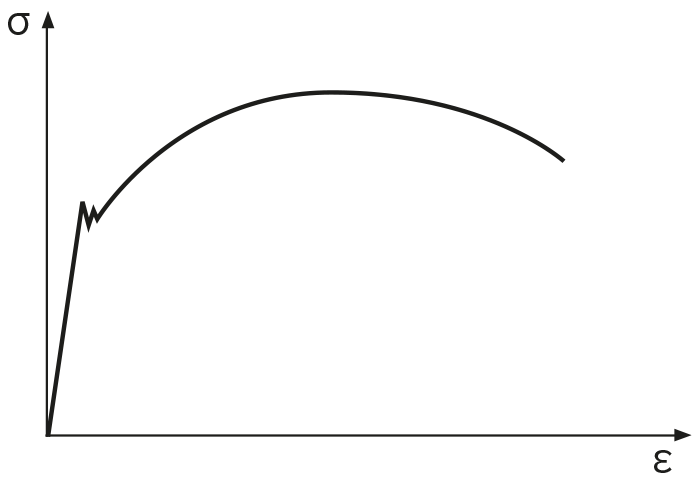
Stress-strain diagram
HARDNESS
Hardness describes a material’s ability to resist indentations – that is, compressions in the surface of a material caused by impacts.There are different measuring techniques (i.e. Rockwell, Vickers and Brinell), which differ in geometry and evaluation methods.A positive effect of roller burnishing is the increase in surface hardness.
HARDNESS TEST ACCORDING TO VICKERS (HV)
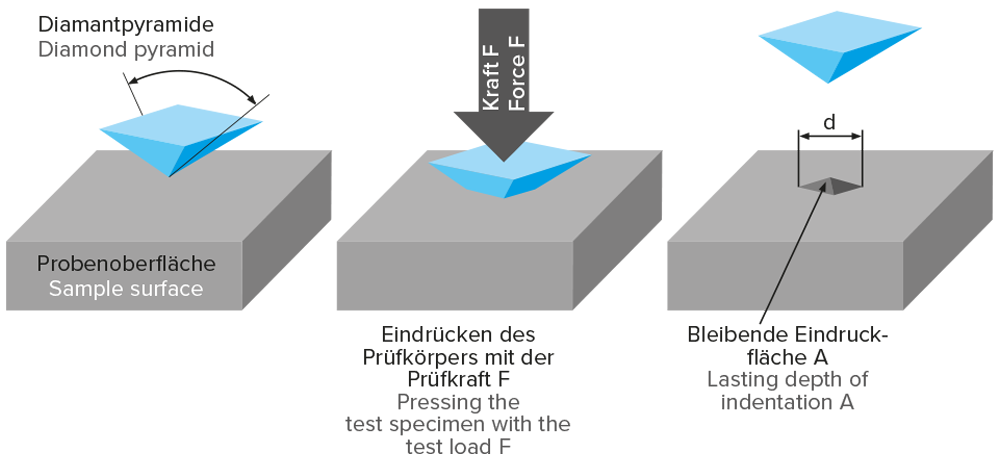
In the Vickers hardness test, a four-sided diamond pyramid is pressed into the material. The indentation surface left behind serves as a measure of the hardness value! The Vickers hardness test is suitable for soft to very hard materials and especially for thin sheets!
HARDNESS TEST ACCORDING TO ROCKWELL (HRC)
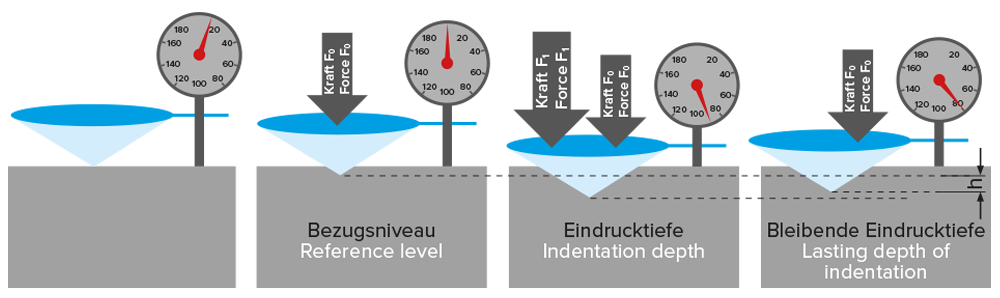
In the Rockwell hardness test, a test specimen is pressed into the material. The indentation depth serves as a measure of the hardness value! Either a hard metal ball or a rounded diamond cone is used as the test specimen.
HARDNESS TEST ACCORDING TO BRINELL (HB)
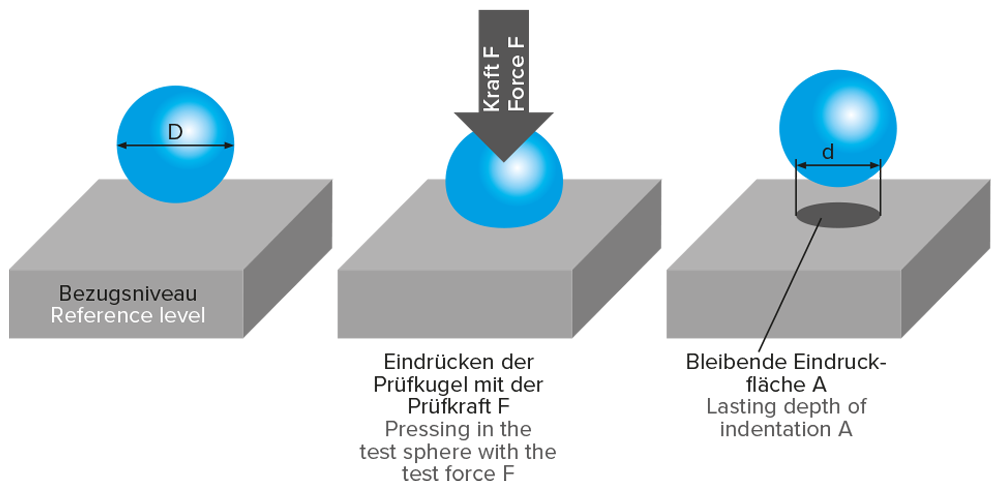
In the Brinell hardness test, a hard metal ball is pressed into the material. The indentation surface left behind serves as a measure of the hardness value!
SURFACE LAYER HARDENING
In order to make components in technical applications durable and resistant, various methods of surface layer hardening can be applied.
For example:
- thermal processes (hardening)
- thermochemical methods (nitriding or nitrocarburizing)
- mechanical methods (roller burnishing)
STRAIN HARDENING THROUGH MECHANICAL METHODS IS BASED ON THE FOLLOWING METHODS:
- cold work hardening by increasing the dislocation density, caused by the formation of new dislocations due to the plastic deformation of the material
- development of residual stresses in the surface layer: residual compressive stresses induced by the stretching of the surface, which is compensated for in the surface layer of the material.
- mechanically induced microstructure transformation
- improvement of the surface quality and consequently reduced notch effect
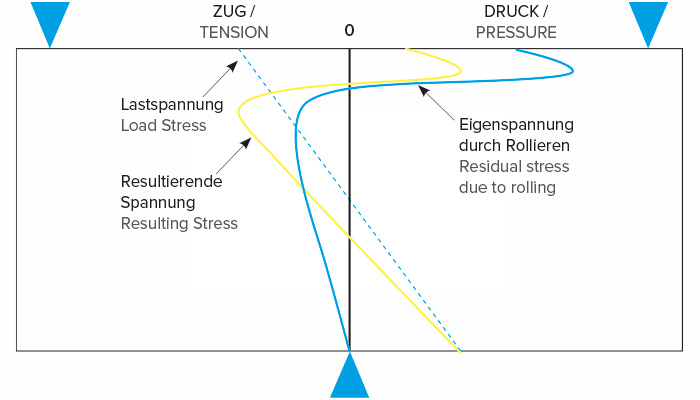
When stressing components, a distinction is made between two types of loads.
1. STATIC LOAD:
This is a constant force on a material by tension, pressure or torsion. The load capacity of the material, beginning with plastic deformation until fracture, can be predicted from the material properties and the load case..
Fmax = Strength × Surface
2. DYNAMIC STRESS
This is understood to mean a stress that changes in periodically recurring intervals. The load can be in the tensile or compression range as well as in the alternating range. With dynamic loading, the load limit is much lower than with static loading. The material performance is usually determined under such a stress and represented in the form of an S/N curve. This curve indicates the stress that can be tolerated as a function of the number of cycles until breakage. Depending on the number of vibration cycles, a distinction is made between static, creep or fatigue strength. The point of failure of components is often a diameter transition, as an increase in stress occurs at these points. Areas with high surface roughness are also often the starting point for component fractures due to the notch effect.